GUIDE 01

Getting Started — your first 30 minutes

Scroll Dungeon keeps the controls simple, but a handful of early rules make a big difference to how fast you grow.

Last updated: 8 August 2026

1. The core loop

One session of Scroll Dungeon is called a run. A run advances purely by swiping up, and always follows the same sequence of nine waves.

StretchWavesWhat happens
Field1–5Regular monsters, treasure chests, and event maps such as campfires and shrines
Dungeon6–8Difficulty steps up and elite monsters appear
Boss9The region boss. Clearing it grants the stage reward
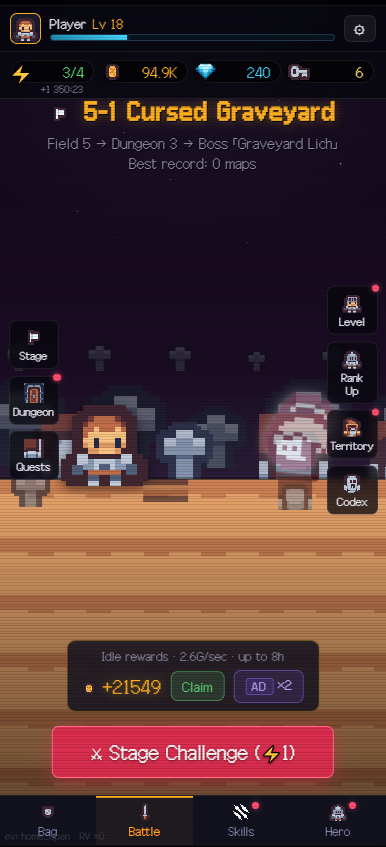
Scroll Dungeon battle tab showing the field-dungeon-boss wave structure, energy counter and stage challenge button
The Battle tab spells out the run structure — Field 5 → Dungeon 3 → Boss — along with your Energy (top left) and the idle reward bar.

Every boss kill raises that region's stage count by one. Monsters get roughly 12% stronger each stage and rewards scale with them, so you can keep farming the same region indefinitely. The label at the top of the screen — something like 1-3 Green Fields — reads as region-stage.

2. Energy decides how long you play each day

Each stage attempt costs 1 Energy. Energy refills on the following schedule.

ItemValue
Maximum Energy4
Cost per stage1
Time to regain 16 hours
Natural regen per day4
Starting Energy (new save)6

So natural regeneration alone gives you four runs a day. A brand-new save starts with six, so your first day has a little extra room.

Out of Energy? — Don't just close the tab. Collect your idle rewards and territory dispatch first. Gold accrues while you're away, but only for up to eight hours. Emptying the meter before bed means nothing is wasted overnight.

The Energy Cap skill card raises your maximum, and Energy Regen shortens the refill interval by up to 60%. Both sit in later tiers, so don't worry about them early on.

3. Loot must be tapped — it is never automatic

This is where new players lose the most. Drops on the ground are not picked up automatically. You have to tap the sparkling item to put it in your bag, and if you swipe to the next map without collecting it, it is gone for good.

Watch out — the urge to swipe the moment combat ends is strong. Pausing for half a second to scan the ground is the single habit that most affects early progression.

Your in-run bag holds 20 items. Once it's full you can't pick anything else up, so equip or clear low-rarity gear mid-run to free space.

4. Swap gear mid-run

You have six equipment slots.

WeaponPrimarily attack
ArmorPrimarily defense and HP
Accessory ×3The most slots, so the biggest total contribution
PetSupporting stats

Gear you find during a run can be dragged straight into the slots at the bottom. If a higher rarity drops, swap immediately — rarity difference dominates everything else. The full multiplier table is in the gear guide.

Note that three of your six slots are accessories. At equal rarity, filling an empty accessory slot raises your total stats more than upgrading your weapon does.

5. Spend run gold on training

On the settlement screen you can train Attack, Defense, and HP with the gold you earned. Each training level gives:

TrainingPer levelEffect
Attack+3Ends waves faster, shortening the whole run
Defense+2Reduces incoming damage, extending survival
HP+20Buys you one more exchange in a boss fight

Put your early gold into Attack. Killing monsters faster means fewer counterattacks, which produces much the same survivability as investing in Defense or HP — and it shortens runs on top of that. Switch to HP once bosses start killing you outright.

6. First 30 minutes checklist

  1. Follow the tutorial to the end. It unlocks the Bag, Skills, Heroes, and Quests tabs in order.
  2. Tap every drop. One extra piece of early gear is very noticeable.
  3. Fill all three accessory slots first. Low rarity beats an empty slot.
  4. Upgrade skills as gold allows. Every third upgrade unlocks a new card, so early upgrades are pure profit.
  5. Reaching level 5 opens most systems. Levelling needs current level × 30 XP, so early levels come quickly.
  6. When Energy runs out, collect idle rewards and territory dispatch, then log off.
Next up — once the loop feels natural, read Gear Rarities & Fusion. From the mid-game onward, managing rarity is the core of progression.